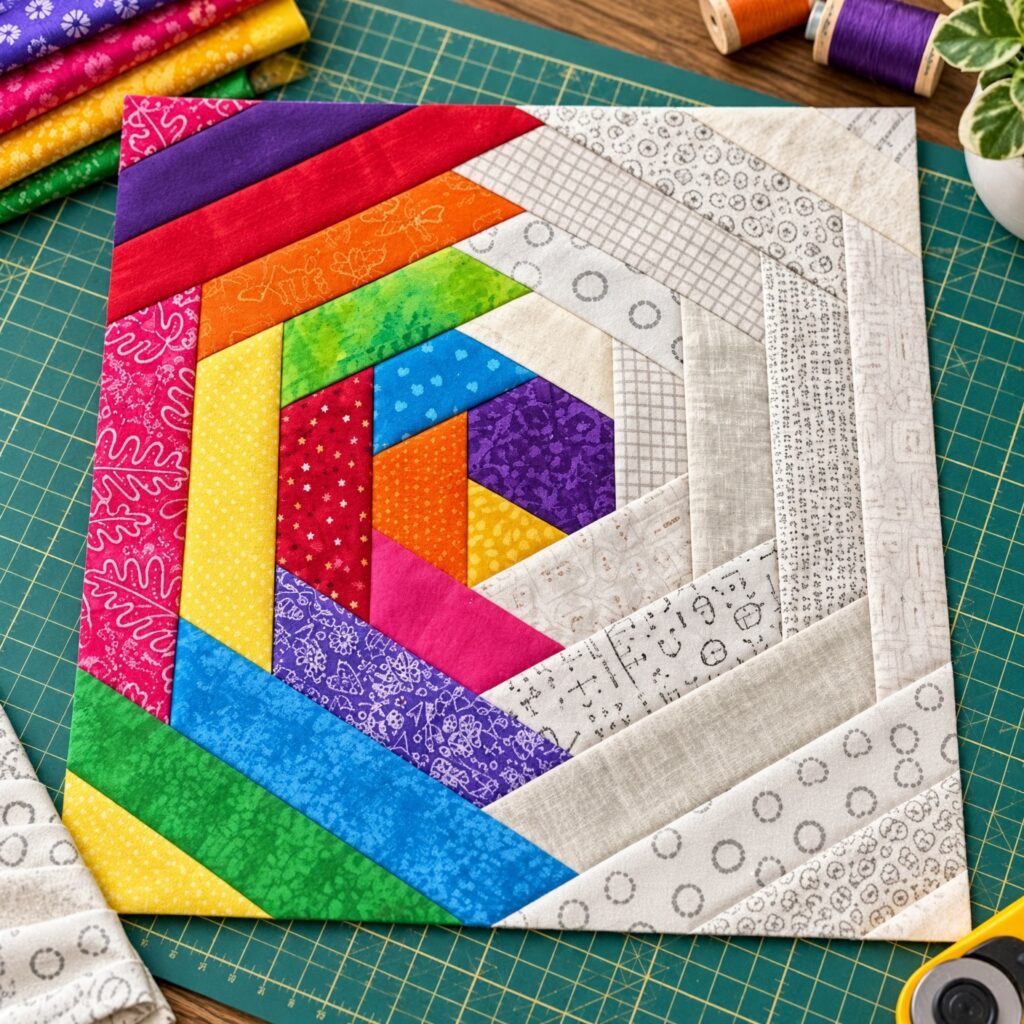
Hexagon Log Cabin Quilt Block Pattern is a colorful and creative variation of the traditional Log Cabin technique, using angled fabric strips to build a striking geometric spiral around a central shape. Inspired by the quilt block shown in the reference image, this project combines vivid rainbow fabrics on one side with soft cream, beige, gray, and low-volume prints on the other. The contrast between bright and neutral fabrics makes the rotating structure especially noticeable and gives the finished hexagon log cabin quilt block a modern, energetic appearance.
One of the most interesting characteristics of the Hexagon Log Cabin Quilt Block Pattern is the way simple fabric strips appear to rotate around the center. Rather than assembling many complicated individual shapes, the design can be developed progressively by adding strips around a central unit. Each new strip extends beyond the previous one and changes direction, gradually producing the recognizable spiral. Careful trimming and consistent seam allowances transform these ordinary strips into a sophisticated geometric quilt block with strong visual movement.
This project is also an excellent opportunity to use fabric scraps. Bright strips in red, orange, yellow, green, blue, pink, and purple can be combined with assorted neutral fabrics to create the dramatic split-color effect visible in the reference design. Because the strips can vary in print while remaining within the same general color family, the finished block has plenty of personality without looking disorganized. In this tutorial, you will learn how to select fabrics, establish the central unit, add strips in sequence, maintain accurate angles, square the block, and use the finished design in larger quilting projects.
Choosing Fabrics and Preparing the Hexagon Log Cabin Block
Begin the Hexagon Log Cabin Quilt Block Pattern by organizing your fabrics into two main groups. The first group should contain colorful fabrics with strong visual impact, while the second should consist of neutral or low-volume prints. This separation is essential because it creates the dramatic contrast that allows the spiral construction to stand out.
For the colorful side, gather strips in shades such as red, orange, yellow, green, blue, purple, and pink. The fabrics do not need to match perfectly. In fact, using several prints and textures can make the block more interesting. Try to maintain enough contrast between neighboring strips so each stage of the spiral remains visible.
For the neutral section, choose cream, white, ivory, beige, and light gray fabrics. Small-scale prints, subtle grids, circles, text-inspired designs, and tone-on-tone patterns are particularly effective. These fabrics are commonly described as low-volume quilting fabrics because they provide visual texture while still reading as light or neutral from a distance.
Decide on a consistent strip width before cutting. Uniform strips create an orderly spiral and make construction easier. Remember that the visible width will be smaller after the quarter-inch seam allowances are sewn. Accurate cutting is especially important because repeated inconsistencies can gradually distort the geometry as the block becomes larger.
You will need a rotary cutter, acrylic quilting ruler, cutting mat, sewing machine, coordinating thread, iron, and ironing surface. A ruler with clear diagonal markings can be particularly helpful when trimming the angled ends. Always follow safe cutting practices when using a rotary cutter.
Before beginning the final block, make a small sample with leftover fabric. A practice piece will help you understand how each strip overlaps the previous one. Once you see the rotation developing, the log cabin construction method becomes much easier to follow.
Building the Center and Creating the Spiral Effect
Start the Hexagon Log Cabin Quilt Block Pattern with a small central geometric unit. The center can be a hexagon-inspired shape, diamond, or another angular unit depending on the exact variation you want to create. In the reference design, several bright fabrics meet near the center and immediately establish the rotating color sequence.
Sew the first fabric strip to one edge of the central piece using an accurate quarter-inch seam allowance. Press the strip away from the center. Pressing after every addition is important because the next strip must be positioned against a flat, accurate edge.
Rotate the block and attach the next strip to the adjacent side. Allow this strip to extend sufficiently to cover the end of the previous piece. Sew, press, and trim the excess. Continue rotating the block in the same direction after every addition.
As you progress, introduce the different colors in a planned sequence. You might move from red to orange, yellow, green, blue, and purple, or arrange the colors according to your own preference. The objective is not necessarily to create a perfect rainbow but to establish a clear color progression that emphasizes the spiral.
On the opposite portion of the block, add your cream, beige, white, and gray strips. Keeping the neutral fabrics grouped together creates the striking division between the colorful and low-volume sections. Each new neutral strip should continue the same rotating construction used on the colorful side.
Frequently place the developing block on your cutting mat and inspect the angles. If one side begins becoming noticeably longer or narrower, correct the problem before adding several additional strips. Small errors near the center can become much more obvious toward the outer edges of a spiral quilt block.
Adding Log Cabin Strips and Keeping the Block Accurate
Continue adding strips around the Hexagon Log Cabin Quilt Block Pattern one at a time. Always follow the same basic rhythm: position the strip, sew the quarter-inch seam, press it outward, trim the excess, rotate the block, and repeat. This consistent workflow helps prevent orientation mistakes.
As the block grows, the strips become progressively longer. Instead of cutting every strip to an exact length beforehand, you may find it easier to use slightly oversized pieces and trim them after sewing. This method gives you more flexibility and helps maintain clean edges.
Pay close attention to fabric placement where the bright and neutral sections meet. These transition points create much of the visual interest. A vivid strip meeting a cream or gray strip produces a crisp boundary that makes the geometric spiral pattern easier to recognize.
Pressing technique also influences accuracy. Rather than aggressively moving the iron back and forth, lift and press it into position. This reduces the chance of stretching angled or bias edges. Allow each section to cool briefly before handling it extensively.
Periodically measure from the center toward several outer edges. The block should expand evenly. If one section is growing more quickly, examine the seam allowances and trimming angles. Maintaining a consistent quarter-inch seam throughout the project is one of the best ways to prevent distortion.
When the block reaches your desired size, complete the final round of strips and press everything carefully. Use a large acrylic ruler to trim the outer edges according to the shape required for your project. Depending on your layout, you can preserve a hexagonal appearance or trim the unit into a square quilt block for easier assembly.
Finishing and Using the Hexagon Log Cabin Quilt Block
Once your Hexagon Log Cabin Quilt Block Pattern has been trimmed, inspect every seam. The strips should lie flat and the spiral should remain visually continuous from the center toward the outer edges. If necessary, make minor corrections before incorporating the block into a larger project.
A single finished block can become a striking quilted pillow, wall hanging, placemat, table topper, tote bag panel, or mini quilt. Because the pattern has such strong visual movement, even one large block can function as a complete decorative composition.
For a larger quilt, create several blocks using the same construction. You can repeat the same color sequence in every block or change the colors while keeping the neutral section consistent. Rotating neighboring blocks can produce secondary diamonds, zigzags, and larger spiral effects across the quilt surface.
When joining multiple blocks, pay attention to where the colorful sections meet. Placing bright areas beside neutral areas can create a scattered, dynamic layout, while aligning similar sections can form larger continuous shapes. Arrange all completed blocks on a design wall or floor before sewing the rows.
After assembling the quilt top, choose a quilting design that complements the strong geometry. Straight-line quilting, echo quilting, or stitching parallel to the fabric strips can emphasize the spiral. A simple overall quilting pattern is another good choice when you want the colorful piecing to remain the main feature.
Complete the project by trimming the quilt sandwich and adding binding. A neutral binding creates a quiet frame, while a bright color can continue the energetic rainbow effect. Once finished, the Hexagon Log Cabin Quilt Block Pattern becomes a wonderful demonstration of how strips, color, contrast, and careful rotation can create sophisticated patchwork.
FAQ About the Hexagon Log Cabin Quilt Block Pattern
What is a Hexagon Log Cabin Quilt Block Pattern?
A Hexagon Log Cabin Quilt Block Pattern is a variation of traditional Log Cabin patchwork in which strips are added progressively around a central geometric shape. Angled construction creates a rotating or spiral-like effect rather than the standard rectangular Log Cabin appearance.
Is this quilt block suitable for beginners?
It is a good project for confident beginners who understand straight seams, rotary cutting, pressing, and the quarter-inch quilting seam. The most challenging part is maintaining accurate angles as the block grows.
What fabrics work best for this pattern?
Quilting cotton is an excellent choice because it is stable and easy to cut accurately. Solids, small prints, tone-on-tone fabrics, batiks, and low-volume fabrics can all work beautifully.
Can I make this block from scraps?
Yes. This is an excellent scrap quilt pattern because the design requires many strips rather than large fabric pieces. Sort your scraps by color or value before starting to maintain a cohesive design.
What are low-volume fabrics?
Low-volume fabrics are generally light-colored fabrics with subtle prints that visually behave almost like solids when viewed from a distance. Cream, white, beige, and pale gray prints are common examples.
How do I keep the spiral from becoming distorted?
Use consistent strip widths and an accurate quarter-inch seam. Press after every seam and regularly trim the developing edges. Correcting small inaccuracies early prevents them from accumulating.
Do all the strips need to be the same width?
No, but consistent widths create a cleaner and more predictable design. Using different widths can produce an interesting improvisational block, although the geometry becomes less uniform.
Can I make a rainbow version of the Hexagon Log Cabin Quilt Block?
Absolutely. Rainbow fabrics work particularly well because the rotating construction naturally emphasizes gradual color changes. Arrange red, orange, yellow, green, blue, and purple fabrics in sequence for a strong rainbow effect.
Can I make an entire quilt with these blocks?
Yes. Multiple Hexagon Log Cabin Quilt Blocks can be repeated and rotated to create a larger quilt. Experiment with block orientation before joining them because different rotations can produce dramatically different secondary patterns.
How should I quilt the finished project?
Straight-line quilting works especially well with this design. You can follow the direction of the strips, echo the central spiral, or use a simple geometric grid. The best option is one that supports rather than overwhelms the piecing.
Conclusion
The Hexagon Log Cabin Quilt Block Pattern offers an exciting way to transform simple fabric strips into a colorful geometric design filled with movement. Starting with a compact central shape and adding strips in a consistent rotating sequence allows the block to expand naturally while developing its distinctive spiral appearance.
Throughout this tutorial, you learned how to select bright and low-volume fabrics, cut consistent strips, establish the central unit, maintain a quarter-inch seam, rotate the block after each addition, press accurately, trim angled edges, and create the contrast between colorful and neutral sections. These fundamental techniques can also be applied to many other Log Cabin and improvisational quilting projects.