Crochet Butterfly Border Edging Pattern is a delicate, elegant, and visually captivating technique that transforms the edges of your crochet projects into something truly special. Whether you are finishing a blanket, baby item, shawl, or decorative piece, learning the Crochet Butterfly Border Edging Pattern allows you to add charm, movement, and a unique artistic touch to your work.
One of the most beautiful aspects of the Crochet Butterfly Border Edging Pattern is how it mimics nature. The repeating butterfly shapes create a flowing, airy design that feels light and decorative. Even though the finished result looks intricate and detailed, the pattern itself is built from simple stitches that are repeated in a thoughtful way.
Another reason why the Crochet Butterfly Border Edging Pattern is so popular is its versatility. You can adapt it to different yarn types, adjust the size of the butterflies, use one or multiple colors, and apply it to a wide variety of projects. This makes it perfect for both beginners who want to learn decorative edging and advanced crocheters looking to elevate their designs.
Materials and Tools for Butterfly Border Edging
Before starting your Crochet Butterfly Border Edging Pattern, it is important to gather all the necessary materials. Using the right tools will make your work easier and improve the final result.
Yarn selection plays a crucial role. Cotton yarn is highly recommended because it provides excellent stitch definition, which helps highlight the butterfly shapes. Acrylic yarn is also a good option if you prefer something softer and more flexible.
You can use the same yarn as your base project for a subtle look or choose a contrasting color to make the butterflies stand out. Multicolor or gradient yarns can also create beautiful effects.
The crochet hook size should match your yarn weight. Typically, a hook between 3.0 mm and 5.0 mm works well for most projects. Using the correct hook size ensures your stitches are neither too tight nor too loose.
Other essential tools include scissors, a yarn needle for weaving in ends, and stitch markers if needed.
Optional tools include blocking mats and pins, which help shape your finished edging and give it a professional look.
Preparing your materials in advance will make your Crochet Butterfly Border Edging Pattern process smoother and more enjoyable.
Understanding the Basic Stitches
Before starting the Crochet Butterfly Border Edging Pattern, it is important to understand the basic stitches used in this technique.
The chain stitch (ch) is used to create loops and spacing within the pattern.
The slip stitch (sl st) is used for joining and creating clean transitions between sections.
Single crochet (sc) provides a firm and stable base.
Double crochet (dc) adds height and helps form the wings of the butterfly.
Treble crochet (tr) can be used for larger, more dramatic wings.
Cluster or puff stitches may be used to add texture and dimension.
By mastering these stitches, you will be able to follow the pattern with ease and confidence.
Preparing the Base Edge
A well-prepared base is essential for a successful Crochet Butterfly Border Edging Pattern.
Start by working a round of single crochet evenly around the edge of your project. This creates a stable foundation for the butterfly motifs.
Make sure your stitches are evenly spaced. Uneven spacing can cause the border to look distorted.
When working along the sides of a project, place stitches at consistent intervals to avoid puckering or stretching.
At corners, add extra stitches—typically 2 to 3 in the same space—to maintain a smooth shape.
Take your time during this step, as a clean base will make the rest of the process much easier.
Creating the Butterfly Motif Step by Step
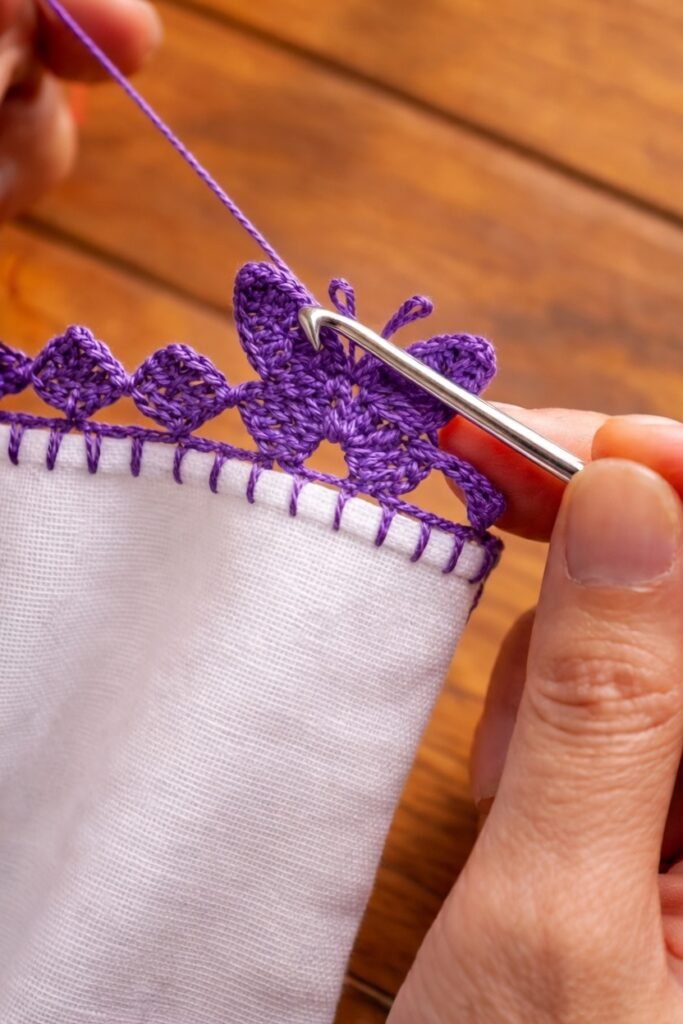
The butterfly motif is the highlight of the Crochet Butterfly Border Edging Pattern.
To begin, attach your yarn to the base edge with a slip stitch.
Chain a set number of stitches (usually 5 to 7) to create the first loop.
Work multiple double crochet or treble crochet stitches into the same stitch or space. This forms one wing of the butterfly.
Chain a few stitches to create separation between the wings.
Work another set of stitches into the same or nearby space to form the second wing.
Finish with a slip stitch to anchor the butterfly.
The combination of loops and grouped stitches creates the distinctive butterfly shape.
Practice this motif a few times before applying it to your project to ensure consistency.
Repeating the Butterfly Pattern Along the Edge
Once you have completed your first butterfly, the next step in the Crochet Butterfly Border Edging Pattern is repetition.
Skip a few stitches along the base edge to create spacing between butterflies.
Repeat the same sequence of chains and stitches to form the next butterfly.
Continue this process evenly across the entire edge.
Maintaining consistent spacing is key to achieving a balanced and professional look.
When you reach corners, you may need to adjust the number of skipped stitches or add extra butterflies to keep the design symmetrical.
Take your time and check your work frequently to ensure everything aligns properly.
Adding Color Variations
Color can dramatically enhance your Crochet Butterfly Border Edging Pattern.
You can use a single color for a classic and elegant look.
Using two colors—one for the base and one for the butterflies—creates a striking contrast.
For a more playful design, use different colors for each butterfly.
Gradient yarn can create a smooth color transition across the border.
When changing colors, do so at the beginning of a motif for a cleaner finish.
Always weave in ends carefully to maintain a neat appearance.
Color experimentation allows you to personalize your project and make it truly unique.
Shaping and Blocking the Finished Edge
Shaping is an important step in the Crochet Butterfly Border Edging Pattern.
Once your edging is complete, fasten off your yarn and weave in all loose ends.
Lay your project flat and gently shape the butterflies with your hands.
If needed, use blocking techniques to define the stitches and improve the overall appearance.
Blocking involves lightly wetting the project and pinning it into shape until it dries.
This step helps the butterflies open up and look more defined.
Creative Applications of Butterfly Edging
The Crochet Butterfly Border Edging Pattern can be used in many creative ways.
Add it to blankets for a decorative and elegant finish.
Use it on baby items for a soft and playful touch.
Apply it to shawls or scarves for a light, airy design.
Decorate table runners, pillowcases, or curtains.
Incorporate it into garments such as skirts or cardigans.
You can even use the butterfly motif as a standalone decorative element.
These possibilities make the pattern incredibly versatile.
Common Mistakes and How to Avoid Them
When working on the Crochet Butterfly Border Edging Pattern, there are a few common mistakes to watch out for.
Uneven tension can cause the border to look inconsistent. Try to keep your stitches uniform.
Incorrect stitch counts can disrupt the pattern. Always count carefully.
Skipping too many or too few stitches between butterflies can affect spacing.
Not preparing the base edge properly can lead to uneven results.
Rushing through the pattern can cause errors. Take your time and enjoy the process.
Being mindful of these issues will help you achieve a better result.
Tips for a Professional Finish
To achieve the best results with your Crochet Butterfly Border Edging Pattern, follow these expert tips.
Practice the motif before starting your final project.
Use high-quality yarn for better stitch definition.
Maintain consistent tension throughout your work.
Take breaks to avoid fatigue and mistakes.
Pay attention to details, especially when working on corners.
These tips will help you create a polished and professional-looking edging.
FAQ About Crochet Butterfly Border Edging Pattern
Is the Crochet Butterfly Border Edging Pattern suitable for beginners?
Yes, beginners can learn it with basic crochet knowledge and practice.
How long does it take to complete?
It depends on the size of the project, but usually a few hours to a day.
What yarn works best?
Cotton yarn is ideal for clear stitch definition.
Can I adjust the size of the butterflies?
Yes, by changing stitch height and chain length.
Is blocking necessary?
It is recommended for the best final appearance.
Conclusion
The Crochet Butterfly Border Edging Pattern is a beautiful and creative way to enhance any crochet project. It combines elegance, texture, and artistic detail into a single technique that can completely transform your work.
By following this detailed guide on the Crochet Butterfly Border Edging Pattern, you will gain the skills and confidence needed to create stunning decorative edges. This pattern not only improves your crochet abilities but also allows you to express your creativity in unique and meaningful ways.